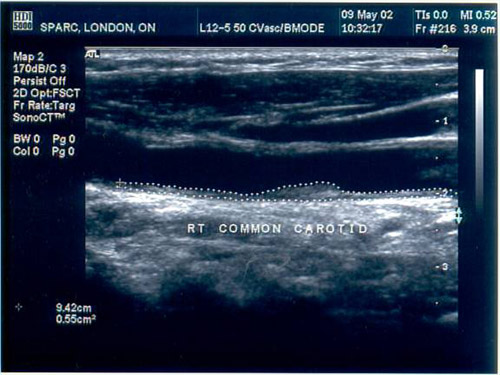
Conclusions: Thirty-eight percent of asymptomatic young to middle-aged individuals with FRS <= 5% have abnormal carotid ultrasound findings associated with increased risk for CV events.
.
Veja essa argumentação no texto:
Clinical Impact of CIMT
Previous studies have shown that high-risk carotid ultrasound results can influence physicians’ recommendations for pharmacologic therapy. Wyman et al found that high-risk carotid ultrasound findings influenced physicians to prescribe aspirin or lipid-lowering therapy in a population with a mean age of 54 years and a mean FRS of 7.8%. In a study of a population with a mean age of 58 years, physicians were also more likely to prescribe aspirin or lipid-lowering therapy on the basis of high-risk carotid ultrasound findings. The findings of our study suggest that in most cases, aspirin, lipid-lowering therapy, or both are initiated for the first time upon the detection of high-risk subclinical atherosclerosis by carotid ultrasound in young to middle-aged individuals who otherwise would not meet criteria by prevention guidelines. .
O que fazer para prevenir eventos nos pacientes de baixo risco? Em todos os congressos existem aulas que afirmam que o número absoluto de eventos em quem é de baixo risco é assustador. O Escore ainda é a melhor opção? . Um dia assisti uma aula cujo título era: “Ações inadequadas que insistimos em fazer apesar de sabermos que estão erradas” .