Ao infinito e além!

Excelente surpresa na enquete de aparelhos novos!

A maioria está interessada em aparelhos avançados.

É esse o caminho! Nós ecocardiografista não podemos nos acomodar.

Aqui na Echotalk já absorvemos o Strain na rotina de exames e cursos, temos planos de 3D para breve, inclusive transesofágico e para o que mais de novo e bom for inventado.

Podem comprar que gente ensina a usar!!!

E para quem vai gastar mais de um milhão numa Tomografia, conselho:

– Gaste também mais uns 10% disso num bom aparelho de Eco que você não vai se arrepender!

Trocar ou não trocar?

Aortic Valve Replacement in the Elderly: Determinants of Late Outcome

Ashikhmina, Elena A. MD; Schaff, Hartzell V. MD; Dearani, Joseph A. MD; Sundt, Thoralf M. III MD; Suri, Rakesh M. MD; Park, Soon J. MD; Burkhart, Harold M. MD; Li, Zhuo MS; Daly, Richard C. MD

Abstract

Background—: Few data exist on long-term outcomes of elderly patients after aortic valve replacement. We evaluated latest follow-up information for patients >=70 years of age after aortic valve replacement.

Methods and Results—: Late overall survival of 2890 consecutive patients >=70 years of age who underwent aortic valve replacement between January 1993 and December 2007 was reviewed retrospectively, analyzed, and stratified by preoperative and intraoperative variables. Observed 5-, 10-, and 15-year late postoperative survival was lower than generally expected (68%, 34%, and 8% versus 70%, 42%, and 20%, respectively; P<0.001). Independent predictors of late death included older age, renal failure, diabetes mellitus, stroke, myocardial infarction, immunosuppression, prior coronary artery bypass grafting, implanted pacemaker, lower ejection fraction, hypertension, and New York Heart Association class III or IV. After stratification by age–comorbidity risk score, 10-year survival for the lowest-risk group (n=946 [33%]) was similar to expected survival (55% versus 55%; P=0.50), but for the highest-risk group (n=564 [20%]), survival was significantly lower than expected (9% versus 26%; P<0.001). For 229 pairs of propensity-matched patients with mechanical or biological prostheses, survival was not significantly different (67%, 40%, and 19% versus 71%, 45%, and 7% at 5, 10, and 15 years, respectively; P=0.81). Structural deterioration of bioprostheses occurred in 64 patients (2.4%).

Conclusions—: Survival of elderly patients after aortic valve replacement is influenced by age and preoperative comorbidities; 33% at lowest risk had overall survival similar to that of an age- and sex-matched general population. There was no sufficient evidence that valve type affected survival. Structural deterioration of aortic bioprostheses was rare.

XXXXXXXXXXXXXXXXXXXXXXXXXXXXXXXXXXXXXXXXXXXXXXXXXXXXXXXXX

Idosos de baixo risco têm taxa de sobrevida similar à população geral após troca de valva aórtica, os de alto risco morrem mais…

Situação difcícil essa!!!

Recordar é preciso 13

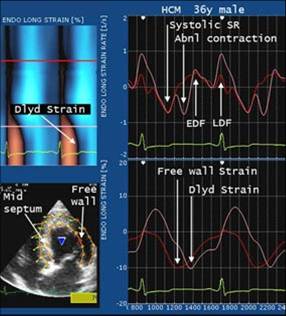
Na Hipertrofia septal assimétrica podemos ver um padrão de Strain com retardo de contração da região septal em relação à parede antero-lateral.

Nas hipertrofias secundárias e hipertrofia fisiológica do atleta isso não ocorre.

Tigragem?

Knock knock knocking on: how to open stuck mitral valve prosthesis

Vihinen, Tapani; Lund, Juha; Airaksinen, K.E. Juhani

Author Information

Division of Cardiology, Department of Medicine, Turku University Hospital, Turku, Finland

Corresponding author. Tel: +358 2 3131005, Fax: +358 2 3132030, Email: juhani.airaksinen@tyks.fi

A 40-year-old man with congenital atrioventricular block and dilated cardiomyopathy presented with rapid worsening of dyspnoea and syncopal attacks during exercise. He had undergone mitral valve replacement 14 years ago and the pacemaker system was upgraded to a biventricular device 7 years ago. Echocardiography revealed severe left ventricular dysfunction (ejection fraction 25%). One disc of the prosthesis was stuck in closed position confirmed by fluoroscopy (Panel A) resulting in mean valve gradient of 8 mmHg (Panel B). Effective anticoagulation combined with aspirin was unsuccessful. New valve surgery was unacceptable and patient was referred for heart transplantation.

Severe symptoms led us to perform a percutaneous mobilization of the stuck prosthesis disc during full anticoagulation. After transseptal puncture, a deflectable ablation catheter was advanced (e.g. through a SL2 sheath) against the stuck disc which was knocked until normal disc motion could be confirmed in fluoroscopy with a decrease in pressure gradient (Panels C–E).

The symptoms ameliorated quickly and patient could be discharged. At 5 months of follow-up visit, the patient was free of syncope, but exercise tolerance had remained impaired (NYHA2–3). Echocardiography showed fully mobile discs with a mean valve gradient of 5mmHg. Later, a similar disc malfunction with a rapid deterioration of the condition was observed, but the patient could be discharged after successful disc liberation.

Our case demonstrates that stuck mitral valve prosthesis can be safely and easily mobilized by catheter manipulation through transseptal route. This quick approach may be helpful first aid in acute life-threatening situations.

XXXXXXXXXXXXXXXXXXXXXXXXXXXXXXXXXXXXXXXXXXXXXXXXX

Cutucaram e prótese do cara anticoagulado, transeptalmente, com catéter de ablação, DUAS VEZES?!

Muito bacana! Adoro essas tigragens…

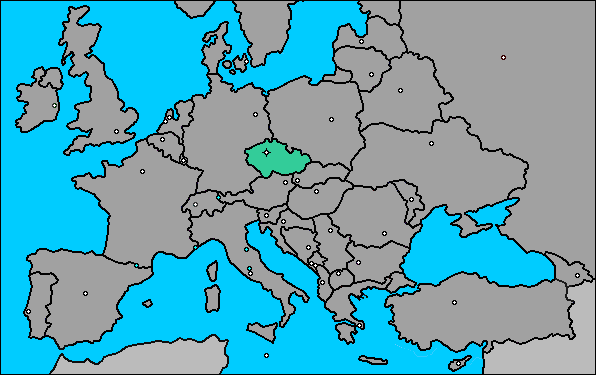
A república Tcheca aceita pedalar para fazer diagnóstico de Insuficiência Cardíaca.

The role of exercise echocardiography in the diagnostics of heart failure with normal left ventricular ejection fraction

.
Methods and results Eighty-four patients with exertional dyspnoea and normal LV EF and 14 healthy controls underwent spirometry, NT-proBNP plasma analysis, and exercise echocardiography. Doppler LV inflow and tissue mitral and tricuspid annular velocities were analysed at rest and immediately after the termination of exercise. Of the 30 patients with the evidence of HFNEF, 6 (20%) patients had only isolated exercise-induced HFNEF. When compared with the remaining patients, those with HFNEF had a significantly lower resting and exercise peak mitral annular systolic velocity (Sa) and the mitral annular velocity during atrial contraction, lower exercise peak mitral annular velocity at early diastole, and lower exercise peak systolic velocity of tricuspid annular motion. The multivariate logistic regression analysis including both parameters standardly defining HFNEF and the new Doppler variables potentially associated with the diagnosis of HFNEF revealed that NT-proBNP, LV mass index, left atrial volume index, and Sa significantly and independently predict the diagnosis of HFNEF.

Conclusion A significant proportion of patients require exercise to diagnose HFNEF. Sa appears to be a significant independent predictor of HFNEF, which may increase the diagnostic value of models utilizing the variables recommended by the European Society of Cardiology guidelines.
.

Immediately after resting echocardiography, symptom-limited exercise was performed by bicycle ergometry (Kettler X7, Siemens, Germany) in a sitting position. The initial workload of 25 W was increased by 25 W every 2 min until the limited symptoms appeared (dyspnoea, leg, or general fatigue). Immediately after exercise, in the patient’s position corresponding to the pre-exercise examination at rest, the following images were obtained: transmitral pulsed Doppler filling flow and Doppler tissue recordings of septal and lateral mitral annular motion and of tricuspid annular motion.

Os Radiocardiologistas são brilhantes!

Cellular adaptive response to chronic radiation exposure in interventional cardiologists
Eur Heart J (2011)
doi: 10.1093/eurheartj/ehr263
.
Methods and results We enrolled 10 healthy exposed professionals (all interventional cardiologists, Group II, exposed: age = 38 ± 5 years) and 10 age- and gender-matched unexposed controls (Group I, non-exposed). Exposed subjects had a median exposure of 4 mSv/year (range 1–8) by film badge dosimetry (below lead apron). We measured reduced glutathione (GSH, a marker of antioxidant response) in erythrocytes and plasma generation of hydrogen peroxide (a marker of oxyradical stress) by ferrous oxidation-xylenol orange assay in plasma. In both groups, lymphocytes were isolated and caspase-3 activity (a marker of apoptotic response) measured at baseline and following 2 Gy in vitro irradiation. Exposed subjects showed a three-fold increase in hydrogen peroxide (Group I = 2.21 ± 1.03 vs. II = 6.51 ± 1.55 μM H2O2 equivalents) and a 1.7-fold increase in GSH (I = 12.37 ± 1.22 vs. II = 20.61 ± 2.16 mM). Exposed subjects also showed higher values of caspase-3 activity, both at baseline and—more strikingly—following high-dose radiation challenge.
.
Conclusion
In interventional cardiologists, chronic exposure to low-dose radiation is associated with an altered redox balance mirrored by an increase in hydrogen peroxide and with two possibly adaptive cellular responses: (i) an enhanced antioxidant defence (increase in GSH, counteracting increased oxyradical stress) and (ii) an increased susceptibility to apoptotic induction which might efficiently remove genetically damaged cells.
.

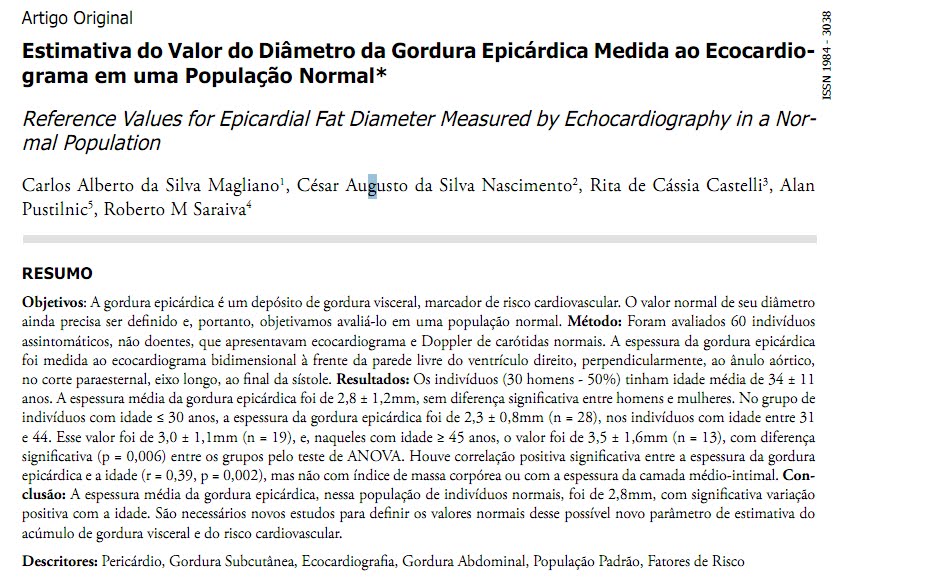
Gordura Epicárdica


Finalmente algo que sempre pareceu óbvio começa a ser estudado com mais afinco!

Gordura epicárdica deve se correlacionar com doença cardiovascular já que se correlacina com ateromatose de quem?

CARÓTIDAS!!!

O ventrículo direito após 69 anos.


.
Caso eviado por Giordano Bruno com achado na valva tricúspide e alteração do VD em paciente de 69 anos.
.
Dê sua opinião.
.