
Use of an automatic application for wall motion classification based on longitudinal strain: is it affected by operator expertise in echocardiography? A multicentre study by the Israeli Echocardiography Research Group
.
Eur J Echocardiogr (2011)
doi: 10.1093/ejechocard/jer182
.
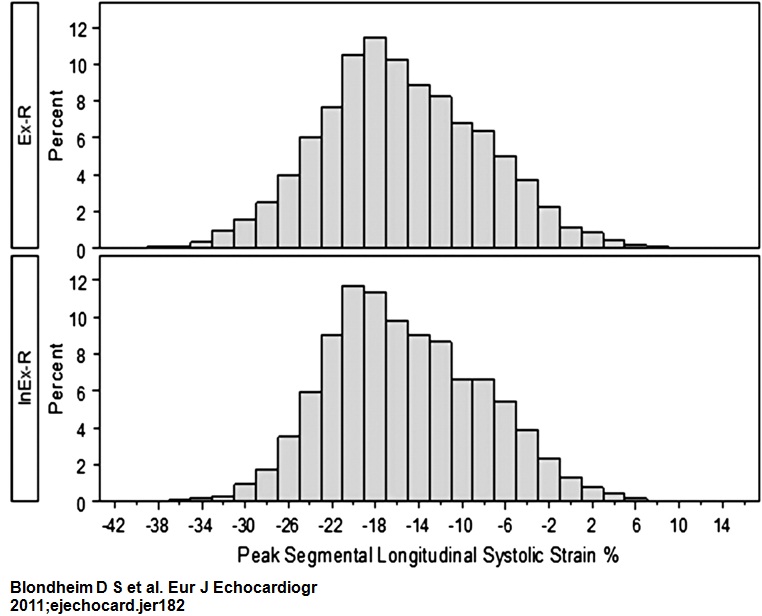
Methods and results We compared the WM classifications obtained by the application when used by 12 highly experienced readers (Exp-R) vs. 11 inexperienced readers (InExp-R). Both classifications were compared with expert consensus classifications using the standard visual method. Digitized clips of cardiac cycles from three apical views in 105 patients were used for these analyses. Reproducibility of both groups was high (overall intra-class correlation coefficient: InExp-R = 0.89, Exp-R = 0.83); the lowest was noted for hypokinetic segments (InExp-R = 0.79, Exp-R = 0.72). InExp-R scores were concordant with Exp-R mode scores in 88.8% of segments; they were overestimated in 5.8% and underestimated in 3.2%. The sensitivity, specificity, and accuracy of InExp-R vs. Exp-R for classifying segments as normal/abnormal were identical (87, 85, and 86%, respectively).
Conclusion Classification of WM from apical views with an automatic application based on longitudinal 2D strain by InExp-R vs. Exp-R was similar to visual classification by Exp-R. This application may be useful for inexperienced echocardiographers/technicians and may serve as an automated ‘second opinion’ for experienced echocardiographers.
.
.
Strain 2d transforma ecocardiografista inexperiente em sábio do ecostress!
.
Estudo demonstra que utilizar o Strain longitudinal dá uma força para quem não têm experiência e acaba acertando o mesmo que os velhos conhecidos do método.
.
E se usar o aprendizado Echotalk de espaço negativo vai acertar 100%…
.
Duas perguntas: 1 Chegamos a era do “Eu, Robô”, no qual as maquinas querem substituir os humanos?
2 – O pais deste estudo não é o mesmo onde são fabricados as máquinas de eco de uma importante empresa de duas letras, a mesma que tem dito ter o melhor strain longitudinal?
Cuidado, em pouco tempo só sobrara limpeza de chão para os seres humanos.
Isso mesmo, inclusive existe uma declaração de conflito de interesses de dois autores!
Calma gente!
A janela tem que ser muito boa, nas ruins ou mais ou menos, o médico ainda é fundamental…