
Dissincronia, só com 3D?

Mechanical dyssynchrony by 3D echo correlates with acute haemodynamic response to biventricular pacing in heart failure patients

.
Europace (2008) 10 (1): 63-68.
.
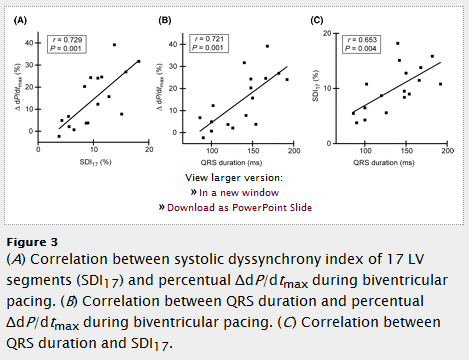
During biventricular pacing, percentual change in dP/dtmaxcompared to the non-pacing mode, ΔdP/dtmax was measured invasively with conductance catheters. LV ejection fraction was 31 ± 10%, SDI17 was 10.2 ± 4.2% and percentual ΔdP/dtmax during biventricular pacing was 14.5 ± 12.4. A significant correlation (r = 0.729, P = 0.001) was found between SDI17 and percentual ΔdP/dtmax, and between QRS duration and percentual ΔdP/dtmax (r = 0.721, P = 0.001).
.
Conclusion The present study suggests that mechanical dyssynchrony measured by RT3DE shows a good correlation with invasively determined acute haemodynamic response to biventricular pacing in patients with symptomatic dilated cardiomyopathy
.
.
A tecnologia com 3D pode dividir o coração em segmentos bem definidos e avaliar a dissincronia de maneira única.
A melhora aguda, porém, pouco significa.
Serão necessários estudos de impacto clínico, mas é um bom começo.
.
Por seu alto custo e demora em ser implantado, muito por ineficiência dos fabricantes, o 3D patina e perde terreno nas pesquisas para as técnicas de Strain.
.
Mas é no Strain que o 3D vai recuperar seu merecido lugar. É só questão de tempo e dinheiro.
.
O que há de certo na dissincronia?

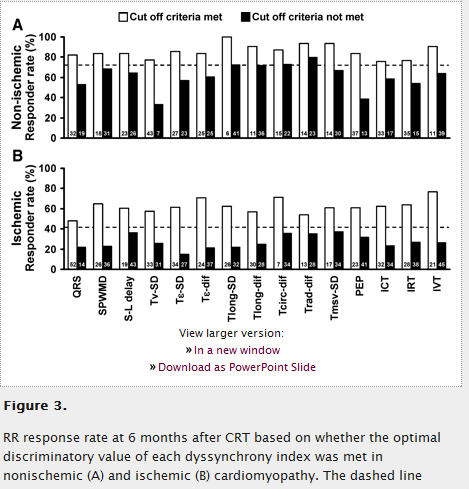
Dyssynchrony Indices To Predict Response to Cardiac Resynchronization Therapy

.
No indices predicted clinical response assessed by Minnesota Living with Heart Failure Questionnaire, 6-minute walk distance, and peak oxygen consumption.
Conclusions— These findings are consistent with the Predictors of Response to CRT study and do not support use of these dyssynchrony indices to guide use of CRT.
.
.
.
O que há de certo na avaliação da Dissincronia ao Eco que não revela benefício para o implante?
.
Texto completo demonstra ausência de benefício em se realizar um número enorme de medidas da Dissincronia.
.
A resposta, está no texto:
Another important and critical question is how much of mechanical dyssynchrony is actually assessed by these echocardiographic parameters. If all proposed parameters do reflect the extent of mechanical dyssynchrony, there should be a consistency among the measurements. However, when we measured both peak systolic tissue velocity timing and peak systolic strain timing before and after CRT, there was a significant shortening of strain timing differences after CRT without a major change in peak systolic velocity timing.17 This finding suggests that different echocardiographic parameters measure different phenomena that may or may not be related to actual mechanical dyssynchrony.
.

Cardiotalk – Aula de coronariopatia com Prof. Otávio

AQUI.
.
http://cardiotalk.blogspot.com.br/ é uma página com casos clínicos e aulas da disciplina de cardiologia da UNICAMP.
São abertas ao público da área médica e ocorrem as Terças, as 8:00 h no prédio da FCM. Salão nobre.
.