http://hyper.ahajournals.org/content/61/3/556.full
.
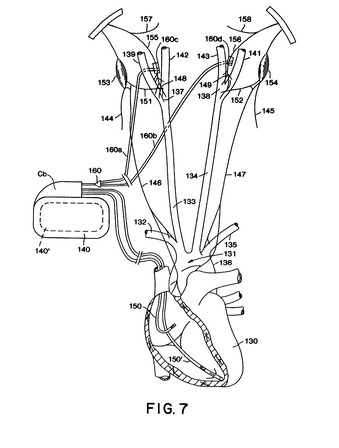
Carotid Body Modulation
As the main peripheral chemoreceptor, the carotid body senses hypoxia and hypercapnia with resultant hyperventilation, sympathetic activation, and increased arterial pressure. The peripheral chemoreceptor reflex has been found to be enhanced in spontaneously hypertensive rats and hypertensive patients. Carotid sinus denervation (denervation of both carotid body and carotid sinus baroreceptors) prevented the development of hypertension in young prehypertensive spontaneously hypertensive rats and significantly decreased arterial pressure in adult hypertensive spontaneously hypertensive rats. With denervation of the carotid sinus baroreceptors, an increase in arterial pressure might have been expected. However, the aortic baroreceptors were intact, and the arterial pressure decrease supports the view that the peripheral chemoreceptor reflex is hypersensitive in spontaneously hypertensive rats. The decrease in arterial pressure was accompanied by a decrease in sympathetic vasomotor tone (blood pressure response to ganglionic blockade).
.
http://hyper.ahajournals.org/content/61/6/1360.full
.
Catheter-Based Renal Sympathetic Denervation for Resistant Hypertension
Durability of Blood Pressure Reduction Out to 24 Months
.
Após o descobrimento dos IECA, o tratamento da hipertensão foi deslocado para o eixo Renina-Angiotensina.
Parecia que o SNC havia abandonado seu papel na hipertensão.
Mas a fisiopatologia apontou sempre o SNC como causador principal da hipertensão “essencial”.
Agora o tratamento voltou para o centro da questão:
Quem mantem o tonus vasoconstrictor nas arteríolas?
Quem mantem a noraepinefrina alta?
.
Na medicina, o que não têm remédio específico fica em segundo plano. Veja o caso do HDL.
Agora que os marcapassos e as intervenções percutâneas agem nos causadores majoritários de hipertensão, tudo pode mudar.
.
Quem faz ecocardiograma está tranquilo. Quanto mais o conhecimento é dinâmico, mais seguro para o método que mais evoluiu em tecnologia.
Que venham os outro métodos! Quero ver quem chega a 150 quadros por segundo!
.