
Insuficiência Aórtica que afeta o fluxo de Carótidas

Figure thumbnail gr1
Serial duplex scans of right CCA. Although carotid flow pattern was normal after previous aortic surgery (A), diastolic flow was reversed before aortic valve surgery (B). After aortic valve replacement, diastolic flow pattern was normalized (C). RT, ; CCA, right common carotid artery.

https://doi.org/10.1016/j.jtcvs.2008.01.010

In the present case, duplex sonography, magnetic resonance angiography, and single photon emission computed tomography findings indicated the 3 following facts in addition to diastolic reverse flow. (1) Reverse diastolic flow reduced total antegrade flow in the right carotid arteries. (2) The right middle cerebral artery received its blood flow from only the right internal carotid artery without any collateral supply. (3) The right middle cerebral artery territory was subject to ischemia with its depressed flow reserve

Fluxo nas Carótidas e Risco de Eventos

Figure.
The stroke incidence in the combined group by tertiles of pulsatility index and tertiles of central systolic blood pressure. *Indicates P<0.05

https://doi.org/10.1161/STROKEAHA.116.013207

Conclusions—

CSBP and common carotid PI jointly and independently predicted future stroke. Carotid flow pulsatility may play an important role in the development of stroke.

Carótidas: Não é só espessura e placa

Figure 1.
Ischemic stroke incidence rate stratified by tertiles (0.60 and 0.48 mm) of intima-media thickness (IMT; mm) and tertiles (15 and 20 cm/s) of end-diastolic velocity (EDV; cm/s). Ischemic stroke incidence was increased by the tertiles of IMT (P for trend <0.0001) and by tertiles of EDV (P for trend <0.0001; P for interaction=0.7973; n=3175)

Association between carotid haemodynamics and inflammation in patients with essential hypertension

https://doi.org/10.1161/strokeaha.110.605477

Conclusions: Common carotid IMT and EDV jointly and independently predicted future ischemic stroke in this Taiwanese population. More prospective studies are required in various ethnic groups to understand the significance and implication of the current findings, particularly with respect to EDV.

Conheça o paciente através das Carótidas

https://www.researchgate.net/publication/5294061_Normal_Reference_Values_of_Ratios_of_Blood_Flow_Velocities_in_Internal_Carotid_Artery_to_Those_in_Common_Carotid_Artery_Using_Doppler_Sonographyr

Estudar as Carótidas de um paciente revela muito da sua história vascular

Pode ser essencial no prognóstico cardiovascular!

Não é só Cálcio que importa!

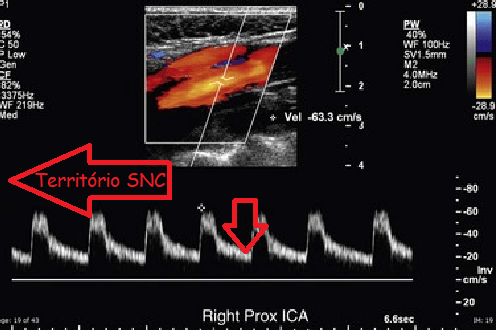
Preste muita atenção no fluxo na carótida interna.

A relação da velocidade máxima com a mínima revela a resistência vascular no SNC

Vale a pena saber!

Não é só a espessura e achados de placas