Estudo inteligente na Hipertrofia Assimétrica.

Standing and Exercise Doppler Echocardiography in Obstructive Hypertrophic Cardiomyopathy: The Range of Gradients with Upright Activity
.Journal of the American Society of Echocardiography

Issue: Volume 24(1), January 2011, p 75–82
.

AB Background: The ideal provocative maneuver in patients with hypertrophic cardiomyopathy (HCM) is a subject of ongoing investigation. Standing is a fundamental activity of daily life. This study examined acquisition of standing, Valsalva, and post-exercise left ventricular outflow tract gradients in HCM. Methods: Rest supine, standing, and post-Valsalva gradients were measured in 98 consecutive patients with HCM who were referred for outpatient echocardiography. In 53 (54%) of the 98 patients, symptom-limited treadmill exercise was also performed, with gradients measured immediately after in the supine position. Results: Fifty-six (57%) of the 98 patients had resting gradient < 30 mm Hg and would thus be characterized as nonobstructive at rest. In the 98 patients, median gradients were 25 mm Hg at rest (range 0-205 mm Hg), increasing to 44 mm Hg after standing (range 0-309 mm Hg), an increase of 76%, and were again higher after Valsalva, 64 mm Hg (range 0-256 mm Hg) (P < .001). In the 53 patients who had gradient assessed after exercise, they were higher still, 100 mm Hg (range 0-256 mm Hg) (P < .001). In 29 patients (30%), standing provoked a higher gradient than Valsalva. 
.
Estudo interessante que avalia o efeito de ficar em pé sobre o gradiente na via de saída.
.
The patient was then asked to stand, and after 2 minutes of equilibration Doppler gradient was acquired over the next minute. To facilitate imaging while standing, the sonographer positioned the patient’s left arm on the patient’s head. This opened rib spaces and improved imaging.
.
Standing gradients were not difficult to acquire; acceptable traces were obtained in 98% of patients attempted by an experienced sonographer.
.
 Conclusion: Although standing increased gradients by 76%, it is not as potent a provocative maneuver as Valsalva or treadmill exercise. Nevertheless, standing is recommended as a physiologic provocative maneuver. In some patients standing may guide therapy; in others, the standing and exercise gradient provide a correct appreciation of the range of physiologically experienced gradients during daily upright activity.
.

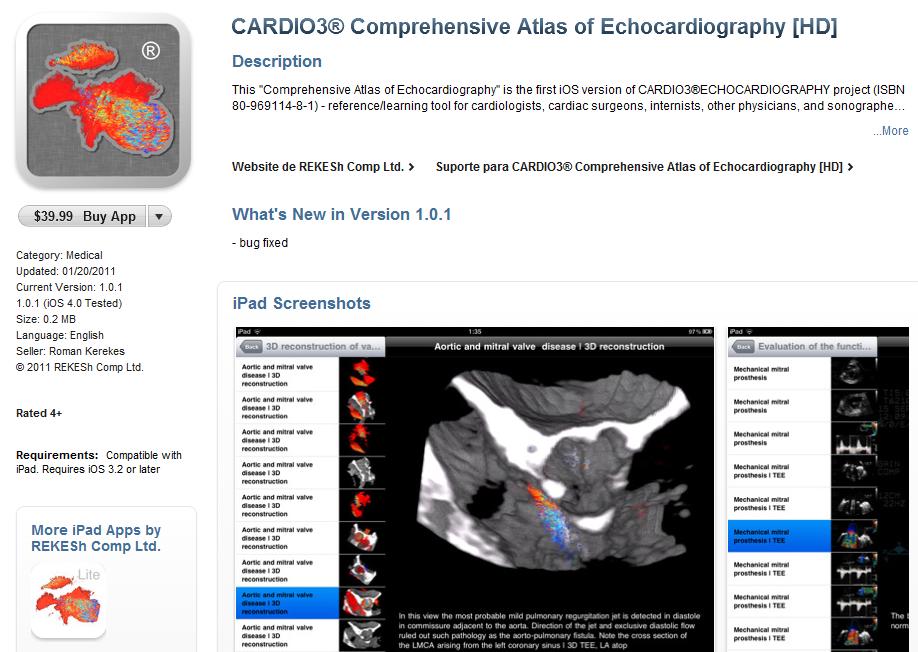
iPad e o Ecocardiograma

.
Você já tem seu iPad?
Ou acha que ele não serve para nada, é apenas uma bobagem de “nerd”?
.

.
O programa acima é muito bom, apesar de caro.
Para ensinar Eco, é fundamental.
.
Quanto tempo vai demorar para instalarem um transdutor de ultrassom nele?
Nesse momento, acredito que já exista!
.
Será que a Terason não está mudando seu Echonotebook para o iPad? Se não está, deveria.
.
Com um cabo, projeta em Datashow ou TV.
.
Todas as aplicações abaixo, são para iPhone mas vão para o iPad, com certeza.

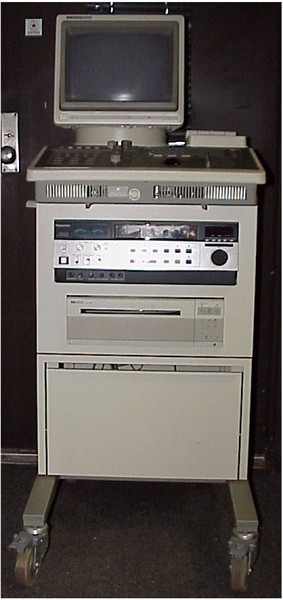
Quanto vale um aparelho velho? Nada. (Velhas histórias)

O mesmo raciocínio vale para um aparelho ruim.
Nada.
Ou menos que nada, pois pode induzir a erro e dar um enorme prejuízo.
.
Hoje soube de uma Aorta bicúspide ao SIM 7000(?!?!) que era normal no Vivid 3.
.
Mas os médicos são os piores empresários, dizia um advogado,  ou são bobos para negócios, ou são tão maus com seus colegas, que até impressionam.
.
Quem usa máquinas de imagem, têm que fazer uma reserva de caixa, do lucro, para trocar as máquinas quando for o tempo.
Falta de condições adequadas de trabalho é motivo para não se expor!
.
Vale a pena repetir essa história:
Após terminar a residência de Eco, fui trabalhar para um ecocardiografista muito conhecido no DEPECO, com cargos e aulas até hoje.
Em um serviço hospitalar, ele tinha um Mark 8 com mais de 12 anos de uso e com o Doppler Contínuo quebrado há um bom tempo. 
Estranhei o fato:
– Doppler contínuo quebrado? Não dá para usar. Como vou ver pressão pulmonar? E em caso de estenose Aórtica, como classificar?
– Ah, disse ele, vai pelo jeitão da válvula e coloca um gradiente!
Saí do serviço na semana seguinte e nunca mais vi a “figura”.
.
Jeitão da válvula…Nunca esqueço essa história.
.

Portugal e o blog EchoTalk

.
O blog tem pelo menos 60 leitores fixos no país que nos encontrou no mundo.
E fazem 264 visitas por mês.
Uma grande honra para esse espaço, que fica comprometido a  merecer a continuidade das visitas.
.

Esse tal de Speckle Tracking…

Estimation of left ventricular filling pressures by speckle tracking echocardiography in patients with idiopathic dilated cardiomyopathy

.
Eur J Echocardiogr (2011) 12 (1):11-18.
.

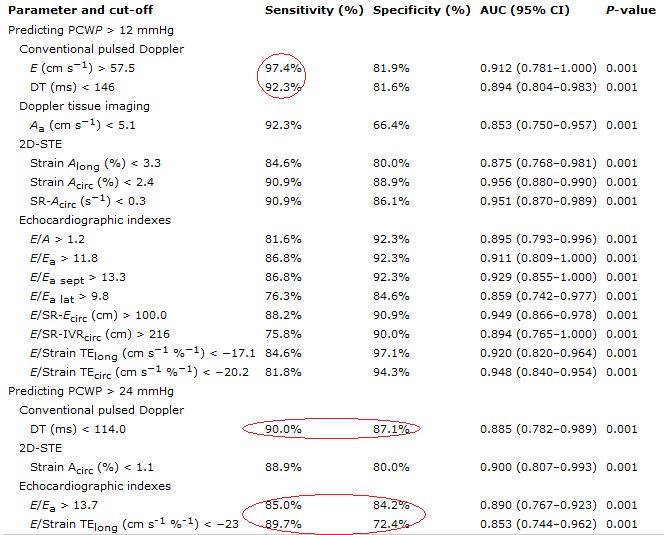
Methods and results Fifty-one patients with idiopathic dilated cardiomyopathy (IDC) underwent pulsed-wave tissue Doppler echocardiography and 2D-STE performed simultaneously with right heart catheterization. Receiver operating characteristic analysis showed that circumferential strain and the SR during late diastolic LV filling (0.956 and 0.951, both P = 0.001), E/circumferential SR at early diastolic LV filling (0.949, P = 0.001), andE/circumferential strain at the time of peak E-wave (0.948, P = 0.001) had greater area under the curve than the E/Ea ratio (0.911, P = 0.001) for the prediction of pulmonary capillary wedge pressure > 12 mmHg.


Conclusion When compared with the E/Ea ratio, several 2D-STE-derived parameters better estimated the increase in LVFP in patients with IDC.

.

.
Está no gráfico acima, repare na diferença de sensibilidade e especificidade dos “velhos” e novos métodos.
.
Todo método em ecocardiografia quando nasce, seu pai-inventor diz: 
– Quando você crescer, vai predizer a pressão de enchimento do ventrículo esquerdo!
rsrs
.
Mas isso não desmerece o Speckle Tracking, pelo contrário, o coloca como realmente promissor na área.
Falta padronizar o método, os softwares e treinar os médicos.
Depois disso, vai no automático.
.