O observador dependente da imagem perfeita

The Value of 2D Strain Imaging during Stress Testing
.
Artigo gratuito.
.
Stress echocardiography is increasingly used but its major limitation is the subjective interpretationof wall motion changes requiring experience. Speckle tracking enables simultaneous evaluation of radial, longitudinal, and circumferential myocardial deformation. Recently, two-dimensional (2D) strain has been found to be as reliable as sonomicrometry for the assessment of left ventricular (LV) regional function. In the presence of inducible ischemia, longitudinal and circumferential abnormalities preceed the decrease in radial deformation. Optimal cutoffs have been obtained from 2D strain rate (SR) at peak dobutamine stress to predict coronary artery disease. However, 2D strain rate does not yet provide incremental accuracy to visual interpretation by experts. Speckle tracking strain could be useful to better identify contractile reverse and biphasic response of viable myocardium but there are not yet clinical studies published in this setting.
.
.
Artigo de 2009 explora a utilidade do Strain 2D na análise ao Stress.
E a busca pela imagem perfeita e independente do observador continua…
.
O Strain 2D só fica bom em imagens nítidas, ás vezes, nem assim.
E quando as imagens são nítidas, qualquer residente iniciante acerta o Ecostress!
.
Quando vejo um radiologista dar laudos em uma pilha de tomografias, vejo laudos examinador-dependentes.
Quando um médico nuclear regula o ganho na tela para comparar paredes justapostas, vejo laudos examinador-dependentes.
Quando a RM demora a rodar ( 8 quadros por segundo?) ou o realce tardio não foi adequado, vejo laudos examinador-dependentes.
.

Infelizmente para alguns, ainda vivemos em um mundo médico-dependente.
.

Substituir o Simpson não é tarefa fácil

Left ventricular strain and strain rate: Characterization of the effect of load
in human subjects
.
European Journal of Echocardiography (2010) 11, 283–289
.
Left ventricular (LV) strain and strain rate have been proposed as novel indices of systolic function; however, there are limited data about the effect of acute changes on these parameters.
.
Simultaneous Millar micromanometer LV pressure and echocardiographic assessment were performed on 18
patients. Loading was altered sequentially by the administration of glyceryl trinitrate (GTN) and saline fluid
loading. Echocardiographic speckle tracking imaging was used to quantify the peak systolic strain (S) and peak systolic
strain rate (SR S) and dp/dt max was recorded from the micromanometer data. GTN administration decreased preload (LV end diastolic pressure [LVEDP]: 15.7 vs. 8.4 mmHg, P , 0.001) and afterload (end systolic wall stress:74 vs. 43 103dyn/cm2, P , 0.001). Administration of fluid increased preload (LVEDP: 11.3 vs. 18.1 mmHg, P , 0.001) and increased wall stress (53 vs. 62 103dyn/cm2, P , 0.003). Administration of GTN resulted in increased circumferential SR S (21.2 vs. 21.7s21, P , 0.01) and longitudinal SR S (20.9 vs. 21.0s21, P , 0.001). The administration of fluid resulted in decreased circumferential SR S (21.5 vs. 21.3s21, P , 0.01) and ongitudinal
SR S (21.0 vs. 20.9s21, P , 0.01). As preload and afterload increased, decrease in circumferential SR S (r ¼ 0.63, P , 0.001; r ¼ 0.56, P,0.001) and longitudinal SR S were observed (r ¼ 0.42, P , 0.003; r ¼ 0.49 P , 0.001).
.
Circumferential and longitudinal peak strain and systolic strain rate are sensitive to acute changes in load, an important factor that needs to be considered in their application as indices of systolic function.
.

.
Vários pesquisadores têm apontado o Strain como método equivalente ou superior ao Simpson.
Mas as influências da pré e pós carga no método são significativas.
Isso também ocorre no Simpson, mas já foi melhor avaliado ao longo do tempo.
.
Enquanto a Fração de ejeção 3D em tempo real não se populariza, vamos de Simpson mesmo!
.

DAC: Doença Arterial de Campinas 2

.
Cooperativa de Campinas autoriza Escore de Cálcio a partir dos 45 anos e Espessura da Carótida só a partir dos 60 anos!
.
Completando 2 meses da nova doença arterial estabelecida pelo comitê de especialistas(?) da cooperativa.
.
E nenhuma organização de saúde ou revista repercutiu essa fascinante descoberta!
.
Mais uma invenção maluca.

Cálcio não têm correlação com a função diastólica!

Coronary Artery Plaque Burden Does Not Affect Left Ventricular Diastolic Function in Asymptomatic Adults with Normal Ejection Fraction
.
Journal of the American Society of Echocardiography
Issue: Volume 24(8), August 2011, p 909–914
.
Background:: Coronary artery disease (CAD) is commonly cited as a mechanism underlying diastolic dysfunction. However, the association of CAD without ischemia and left ventricular (LV) diastolic dysfunction has not been convincingly demonstrated in asymptomatic patients. The objective of this study was to determine if such a relation exists using coronary artery calcium score (CACS) as a surrogate for coronary atherosclerosis burden.
.
Conclusions:: In asymptomatic patients with normal LV ejection fraction and negative cardiac stress test results, CACS does not correlate with LV diastolic function as defined by established Doppler echocardiographic criteria. In the absence of ischemia, postinfarction LV remodeling, or previous coronary artery bypass surgery, CAD does not appear be a cause of LV diastolic dysfunction in asymptomatic patients.
.

Um tubo só para o corpo inteiro.

Carotid Artery Stiffness and Diastolic Function in Subjects without Known Cardiovascular Disease
.
Journal of the American Society of Echocardiography
Issue: Volume 24(8), August 2011, p 915–921
.
Background:: The aim of this study was to investigate the relationship between carotid artery stiffness and diastolic function in a cohort of subjects without known cardiovascular risk factors and/or overt cardiovascular disease
.

Results:: Stiffness parameter and Ep were correlated inversely with transmitral E wave (P < .01), E/A ratio, and septal Em (P < .01) and positively with A wave (P < .001). IMT was also associated with A wave, E/A ratio, Em, and Am but not with E wave. The correlation between arterial stiffness and left ventricular diastolic function remained significant after multivariate adjustment for age, sex, pulse pressure, and body mass index, but not with IMT.
.

Parâmetros de elasticidade da Carótida se correlacionam com a função diastólica, sugerindo uma relação íntima da circulação central e periférica.
Mais uma evidência da doença arterial como patologia do corpo inteiro e não limitada a placas.
Conceito óbvio mas ignorado no diagnóstico e tratamento do risco cardiovascular.

.

Recordar é preciso 12

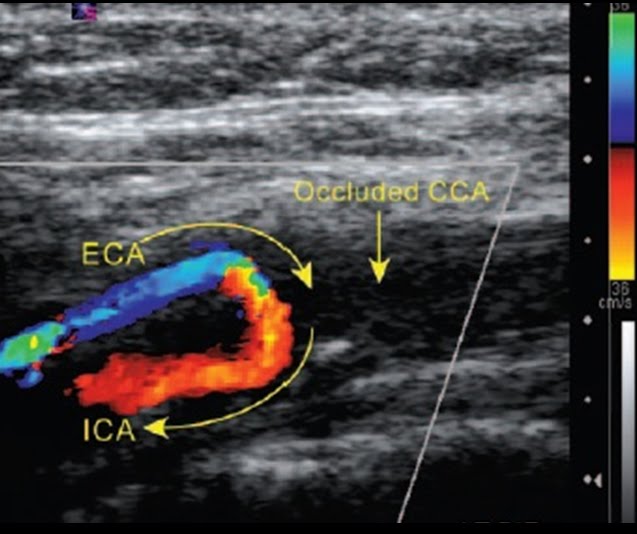
Na oclusão da carótida comum (unilateralmente), vemos um fluxo retrógrado vindo pela externa, que tem comunicação com as artérias contra-laterais pelos seus ramos.

Viabilidade miocárdica

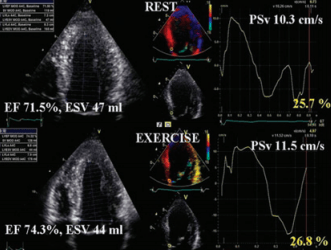
Confirmando, na prática, o post do Prof. José Roberto sobre viabilidade e strain de repouso…

E, sim, ecostress de esforço também pode mostrar viabilidade!

A dança do miocárdio na insuficiência mitral.

Cardiac Resynchronization Therapy as a Therapeutic Option in Patients With Moderate-Severe Functional Mitral Regurgitation and High Operative Risk
Circulation
.
we assessed the severity of MR using a multiparametric approach, which combined the following measurements: (1) vena contracta width (VCW), measured as the narrowest portion of the MR color Doppler jet in a zoomed optimized parasternal long-axis view or in the apical 4-chamber view; (2) the ratio of the jet area to the left atrium (LA) area measured by planimetry in the 4-chamber view; (3) the effective regurgitant orifice area (EROA) calculated with the proximal isove- locity surface area method.
.
Conclusions—Cardiac resynchronization therapy is a potential therapeutic option in heart failure patients with moderate-severe functional MR and high risk for surgery. Improvement in MR results in superior survival after.
.
Agora sim a ressincronização encontrou um uso inteligente.
Em pacientes com QRS de 160ms e refluxo mitral acentuado, a ressincronizção reduz significativamente o volume do átrio esquerdo e parâmetros de regurgitação. Pois a dissincronia atrapalha muito a função dos papilares e o fechamento da valva mitral na sístole. Esse refluxo eleva a pressão atrial e acentua os sintomas limitantes. E a avaliação do refluxo ao Eco usou parãmetros incontestáveis!

.