

.
O blog terá agora uma seção de oportunidades, para quem procura ecocardiografistas e para quem procura uma vaga.
Escreva para o blog e faça seu pedido que será publicado.
Dia: 1 de julho de 2009
O futuro da ecocardiografia
The future of echocardiography
Thomas H. Marwick*
Department of Medicine, Princess Alexandra Hospital, University of Queensland, Brisbane QLD 4102, Australia
European Journal of Echocardiography 2009
.
Portáteis:
The availability of relatively inexpensive, portable echocardiography
machines may have a major impact on the
identification and management of cardiac disease in the
developing world. The ability of high-technology echocardiography
to operate in a low-infrastructure environment
(even with battery and solar power where mains electricity
is not available) is unique among the imaging techniques.
Already, a landmark study in Mozambique and Cambodia
has documented a 10-to-15-fold increase in the identifi-
cation of rheumatic heart disease with echocardiographic
rather than clinical screening.
.
3D:
The eventual goal of 3D imaging will be to provide a series
of 3D data sets, minimizing imaging time or even obtained
remotely. At present, the image quality provided by 3D
data sets does not compete with 2D imaging on the basis
of either temporal or spatial resolution, with the result
that diagnoses may be missed by the interrogation of 3D
data sets alone.29 It seems likely that technological
advances will remedy these shortcomings, permitting acquisition
of a 3D data set, with offline processing to provide a
series of 2D data sets independent of the expertise of the
acquiring sonographer.
.
Microbolhas:
Despite data showing that myocardial contrast improves
the accuracy and prognostic value of stress echocardiography,
the use of microbubbles for the assessment of myocardial
perfusion remains an ‘off-label’ application. The
regulatory approval of two new agents has been declined
for safety and/or efficacy reasons, with the approved
agents being a decade old. Thus, despite the promise of
these agents for facilitated thrombolysis, gene delivery,
and for targeted imaging for the detection of thrombi
and inflammation, the future of this field remains
uncertain.
…..
Use o tradutor no canto esquerdo da pagina!
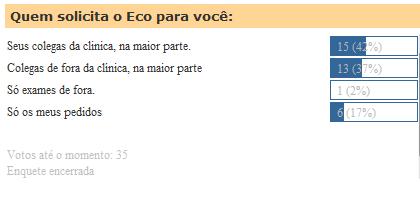
Você faz Eco para quem?
.
1- 42% fazem Eco para os colegas da clínica, na maioria.
Posição bastante confortável, já que a demanda é controlada. Resta controlar os custos da clínica, que geralmente pesam no lucro.
.
2- 37% fazem para colegas externos, na maioria.
Posição de máximo lucro, onde os custos são apenas relacionados à execução. Porém, dependente de uma demanda que pode mudar de mãos.
.
3- 17% fazem só os próprios pedidos
Situação perfeita para volumes baixos de exames, mas sempre pode ser melhorada com pelo menos um pouco de exames externos.
.
4- 2% fazem exames externos apenas.
Situação rara atualmente, geralmente acontece em cidades grandes, em laboratórios múltiplos de imagem.
….
Acredito que as opções 1 e 3, vão predominar ao longo do tempo, devido aos custos mais baixos de equipamentos e o número maior de executores disponíveis.
.
Alan Proust dizia que o segredo de seu sucesso no automobilismo se devia a capacidade de antecipação dos movimentos dos concorrentes e das condições da pista e da sua capacidade de aproveitar integralmente as oportunidades surgidas.
Simples assim.