.
O uso da deformação para análise da sístole e diástole é recente.
Duas tecnologias, se não forem três, disputam espaço no mercado.
.
Dez por cento dos aparelhos nacionais realizam uma das três metodologias.
Dois ou três centros do país ensinam(?) o uso da técnica.
.
Em uma pesquisa básica no Pubmed, 346 artigos usam diferentes técnicas com máquinas não pareáveis.
.
Livros textos, são escritos por realizadores iniciantes.
Artigos, são feitos por pesquisadores sem preocupação como uso clínico.
.
Com todas essas ressalvas, o simples mortal e ecocardiografista têm que saber responder a pergunta acima…
Mês: junho 2012
DOBUTAMINE ECHOCARDIOGRAM / ECHOCARDIOGRAPHIE DE STRESS NORMAL
.
Mesmo com o uso do Strain, parece que a positividade foi ignorada na apical lateral e apical verdadeiro.
Não dá para enxergar direito mas parece que o Strain sistólico está reduzido na figura justamente na região apical lateral…
.
Infarto ANTERO-SEPTAL/ 3D ECO – Pós processamento
.
Vejam o uso do 3D para fazer cortes transversais por todo o VE e evidenciar o infarto antero-septal.
.
A perda de resolução é sensível, como acontece no modo M anatômico.
.
ESAOTE MY LAB ALPHA
.
E os portáteis Esaote vão mudar completamente!
Após regime e plástica, o transportável ficou realmente portátil.
.
Ainda sem venda no Brasil para ecocardigrafia, mas vale a pena esperar.
.
Esaote – MyLab Seven
.
A máquina é muito boa.
A promessa é de um aparelho topo de linha por preço de intermediário.
Já aprovada para vendas no Brasil.
.
Como a segunda mais desejada no país, segundo pesquisa do blog, a Esaote promete uma aparelho superior para àqueles que querem entrar no mundo do Strain sem gastar um caminhão de dinheiro.
.
Vscan: Bom para o ruim e ótimo para o bom.
Diagnostic Utility and Clinical Usefulness of the Pocket Echocardiographic Device
.
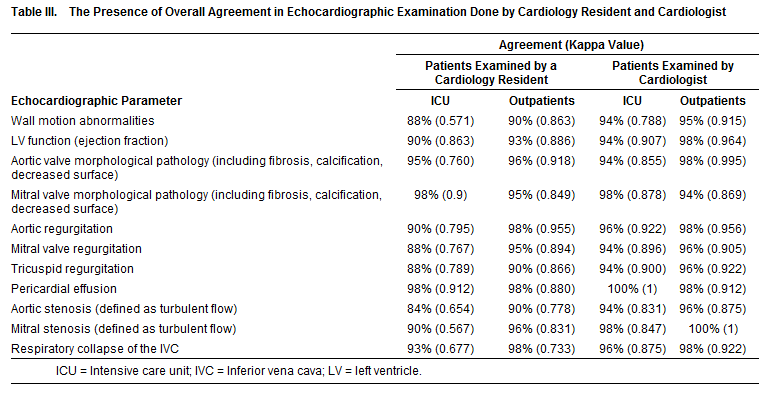
Results: 96% of patients had echocardiographic measurements completed by both PE TTE and sTTE. The dimensions measured with PE TTE by the resident and the cardiologist showed good to excellent correlation with sTTE (r = 0.64–0.96, P < 0.001). The agreement in detection of various pathologies between PE TTE performed by the resident and sTTE examinations was moderate to very good, whereas it was good to excellent if PE TTE was performed by the experienced cardiologist.
.
Conclusion: The diagnostic accuracy of the PE in basic assessment of cardiac morphology and function as compared to standard echocardiography is moderate to very good for a cardiology resident and good to excellent for an experienced cardiologist. (Echocardiography 2012;29:1-6)
.
.
É assim:
Nas mão de um ecocardiografista treinado, o Vscan é quase um Eco completo.
Nas mãos de um residente de Eco, o Vscan é bem melhor que o estetoscópio!!!!
.
A nossa guerra fiscal e o Padre Vieira.
Oscar de idéia mais maluca da ecocardiografia
Detection of Wall Motion Abnormalities during Ambulatory Echocardiography Using a Novel Ultrasound Transducer
.
Aqui
.
Background: This investigation was designed to determine whether transient wall motion abnormalities due to myocardial ischemia induced by walking could be detected by ambulatory echocardiography. Methods: Two groups were studied. Group 1 consisted of 10 males (mean age 34 years) who had no symptoms of angina. Group 2 consisted of eight selected patients (mean 61 years) with angina and angiographic evidence of coronary artery disease.
.
The 2.5 MHz transducer is spherical in its distal part and mounted in an external housing to permit steering in 360°. The external housing was attached to the chest wall using an adhesive patch. The transducer was placed in the 3rd or 4th intercostal space at the left sternal border to permit imaging of the left ventricle (LV) in its short axis and attached to the chest wall. The transducer was interfaced with an Acuson Cypress echocardiography system which was placed on a mobile cart.
.
To permit portability, the echocardiography system was powered by a capacitor (UPS device). The subjects were asked to walk along the corridor as fast as possible for 10 minutes or until the onset of symptoms while pushing the cart. The short axis of the LV was displayed on a monitor and recorded on optical disks. Results: The heart rate, systolic blood pressure (SBP), and double product of Group 1 at rest were 77 ± 3 beats/min, 119 ± 13 mmHg, and 9,150 ± 868, respectively, and increased to 106 ± 8 beats/min, 129 ± 15 mmHg, and 1,3793 ± 2,176 with walking. The baseline heart rate, SBP, and double product were 71 ± 12 beats/min, 130 ± 14 mmHg, and 8,555 ± 1,928 in Group 2 and increased to 94 ± 14 beats/min, 135 ± 20 mmHg, and 12,480 ± 3,830 with walking. All patients in Group 1 had normal wall motion at rest and during walking. Patients in Group 2 had normal wall motion during rest and new wall motion abnormalities were noted in all subjects during walking (anterior septum and/or anterolateral wall in seven, posterolateral wall in one). The wall motion abnormalities resolved shortly after discontinuation of walking. Conclusion: Ambulatory echocardiography permitted the detection of transient wall motion abnormalities in patients with coronary artery disease (CAD). This technique could be potentially useful in evaluating selected patients for myocardial ischemia. (Echocardiography 2012;29:509-512)