
Systolic time intervals as simple echocardiographic parameters of left ventricular systolic performance: correlation with ejection fraction and longitudinal two-dimensional strain
Systolic time intervals
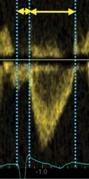
Based on pulsed Doppler aortic acquisitions, STI were obtained:
aortic pre-ejectional period (PEP: delay from Q wave of QRS to aortic
valve opening, ms) and LV ejection time (LVET, ms). In simple terms,
PEP is the interval from the onset of ventricular depolarization to the
beginning of aortic ejection. LVET represents the interval from beginning
to termination of aortic flow. PEP/LVET ratio was also calculated.
.
Conclusion STI can be easily and accurately measured in
clinical practice, and may be used for detecting alterations
in LV systolic function. Moreover, this method is likely to
have potential applications in the management of HF patients.
.
Tudo que é simples é melhor?
Parece que nesse caso é verdade.
Veja a variação entre as medidas, maior defeito de outros
métodos que avaliam fração de ejeção:
“mean intra-observer variability was 7.6% for PEP, and 4.3% for LVET.”
.
Descubra mais sobre EchoTalk Echocardiography
Assine para receber nossas notícias mais recentes por e-mail.