

.
.
Left ventricular (LV) short-axis views at the apical, mid, and basal levels, and LV apical four, two and three-chamber views were acquired, using a frame rate >44 frames/sec. At each plane, 3 consecutive cardiac cycles were obtained at end-expiration breath holding and stored digitally for offline analysis. Image analysis was performed off line on a PC workstation using custom analysis software (Echopac PC, Version 7.0.X; GE Healthcare, Fairfield, CT, USA). Color tissue Doppler was measured off-line at the septal and lateral mitral valve annulus, e′ waves were obtained. The mean value of the septal and lateral e′ was used to calculate the E/e′ ratio.
.
In a subgroup of asymptomatic patients with Chagas’ disease without evident cardiac involvement, 2D strain was reduced compared with healthy individuals, suggesting incipient LV dysfunction in these patients. 2D ST strain has the potential for detecting early myocardial impairment in the setting of Chagas’ disease.
.
Marcação com Speckle Tracking revelou alterações em alguns segmentos de pacientes chagásicos.
Seria um marcador fino de alterações da doença no miocárdio antes de afetar a condução ou concomitantes com as alterações elétricas?
Chagas continua sendo um mistério em sua fisiopatologia.
Estudo elegante e instigante.
.
.
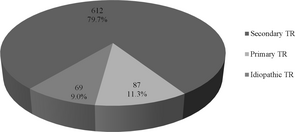
Prevalence and Spectrum of Conditions Associated with Severe Tricuspid Regurgitation
.
.
Volume 31, Issue 5, pages 558–562, May 2014
.
Tricuspid regurgitation was graded severe based on jet area and/or the ratio of jet area to right atrial size accompanied by a dense continuous-wave Doppler profile and/or systolic flow reversals in the hepatic veins on pulsed-wave Doppler.
.
Opa, métodos utilizados para classificar o regurgitação muito dependentes do ColorDoppler!
.
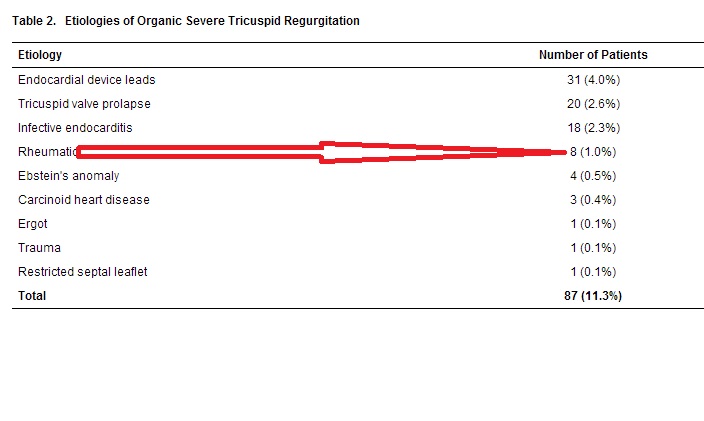
Severe TR occurred with a prevalence of 1.2% in our patients referred for echocardiography and was more common in females. Functional severe TR was the most common etiology with only a minority of cases secondary to organic severe TR. Idiopathic severe TR was found in a small proportion of patients who were older and more likely to have atrial fibrillation.
.
Só 1% de reumáticos!!!!
.
.